
For industry
Energy performance you can run in-house.
For industrial and commercial operators who want to understand their energy performance, find savings, and access utility programs — without standing up an internal energy team or hiring a consultant for every step.
Who this is for
Three common starting points.
Wherever you are in your energy journey, EnergyIntel meets you there.
I'm new to energy management.
Start with a benchmark. Upload your utility bills, answer a few questions about your facility, and EnergyIntel will tell you where you stand and where the obvious opportunities are.
- Upload bills, get a benchmark
- Guided facility profiling
- First conservation measures identified
I know we're wasting energy — I just need to prove it.
Move past the spreadsheet. Quantify each opportunity against a standardized BEF benchmark, support your utility incentive applications, and walk into your next capital review with defensible numbers.
- BEF-normalized ECM quantification
- Support for DSM incentive program applications
- Ranked priority list with payback
I'm running an ongoing energy program.
Manage benchmarks across multiple facilities, track performance against baseline, surface new opportunities continuously, and report up the chain — all from one platform.
- Multi-facility portfolio view
- Continuous performance tracking
- Automated reporting
How it works
Five stages. One continuous cycle.
EnergyIntel guides you through every stage of the energy performance lifecycle — and back again. Discover where you stand, evaluate what to improve, implement the plan, verify it worked, and monitor performance over time. Operations evolve; the cycle keeps pace.
Every assessment is grounded in BEF — the Benchmark Energy Factor.
- 01
Discover
Where do I stand?
- 02
Evaluate
What can I improve?
- 03
Implement
What's the plan?
- 04
Verify
Did it work?
- 05
Monitor
How's it performing?
- and back to Discover
Stage 1 of 5 · Discover
Discover — establish where you stand.
Every assessment is grounded in BEF — the Benchmark Energy Factor — a physics-based measure of how much energy a facility or system uses versus how much it essentially needs. BEF is a published, physics-based method — the same approach applied to every system type.
BEF works at the level that matches your question. Benchmark a whole facility for a portfolio view; benchmark an individual system when you need to know exactly where energy is going. Assessment depth scales with the data you can provide — from a quick utility-bill benchmark to a detailed, sub-metered analysis.
- One methodology, applied at facility or system level
- Choose your depth: from quick benchmark to detailed analysis
- Baseline + reporting period tracking built in
Stage 2 of 5 · Evaluate
Evaluate — find and size the opportunities.
With the benchmark in place, EnergyIntel highlights where the largest gaps between essential and actual energy use exist. Equipment profiling — guided by the EI Coach — captures the operational details that turn a benchmark gap into a list of specific, actionable conservation measures.
Each identified measure is then quantified — annual energy savings, demand reduction, payback period, capital cost — against the same standardized BEF benchmark. No back-of-the-envelope guesses; every number is defensible.
- Guided equipment profiling via the EI Coach
- BEF-normalized savings calculations per measure
- Ranked priority list with cost, payback, and demand outputs
Stage 3 of 5 · Implement
Implement — act on the plan.
Implementation is where measures move from a list to operations. EnergyIntel produces the supporting documentation each measure needs — measure description, BEF-based savings calculations, baseline evidence, methodology references — in a structured form that supports utility DSM incentive program applications.
The output is structured documentation that goes into an application — not a finished submission. Your team, a consultant, or your utility's program intake process takes it from there.
- Structured measure documentation per ECM
- BEF-based savings calculations with traceable methodology
- Supports DSM incentive program applications
Stage 4 of 5 · Verify
Verify — confirm the savings are real.
Once measures are implemented, EnergyIntel tracks ongoing performance against the baseline. BEF performance reports are generated automatically from live operating data — so you can show, not just claim, that the savings landed.
Reports are not snapshots. They're living, refreshable documents that update as new data arrives.
- BEF performance reports against baseline
- Refresh on demand as data updates
- Defensible savings claims with full methodology trail
Stage 5 of 5 · Monitor
Monitor — stay improved.
Operations evolve. Equipment ages, production shifts, weather changes. EnergyIntel re-benchmarks continuously, surfaces new opportunities as conditions change, and flags performance drift before it becomes a problem.
Continuous monitoring closes the loop — what started as a one-time benchmark becomes an ongoing practice.
- Continuous re-benchmarking against current operations
- Drift detection and alerting
- New opportunities surfaced as conditions change
The EI Coach
Plain-language guidance, anytime.
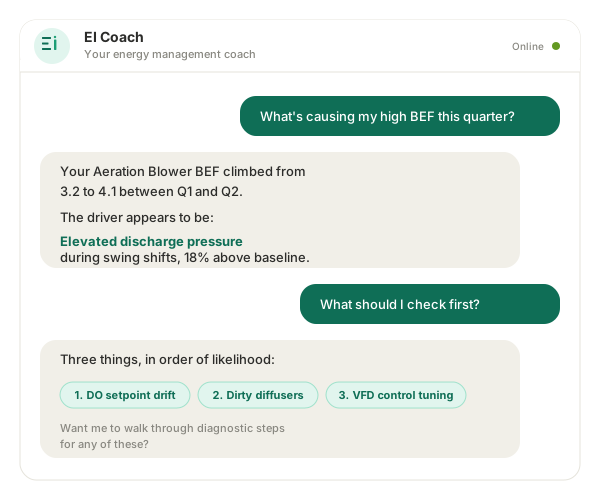
The EI Coach is the AI-powered assistant built into every stage. Ask what your benchmark means. Ask why one measure ranks higher than another. The coach knows the BEF methodology, the equipment, and the calculations — and points to the right next step.
- Walks you through equipment profiling and ECM identification
- Explains the methodology behind every number
- Surfaces the right next step at every stage
Start measuring your energy performance today.
Free to start. No credit card. Cancel anytime.